Showing posts with label U.S.. Show all posts

Sunday, March 12, 2017

Wacky Winter Weather: Record Warmth in Buffalo and U.S. - Linked to Global Warming?

By David Kowalski

February 2017 was the second warmest February in the 123-year period of record for the contiguous U.S., according to data from the National Oceanic and Atmospheric Administration. The average U.S. temperature was 41.2°F, a whopping 7.3°F above the 20th century average.

Nearly one-quarter of the U.S. showed record warmth in February (NOAA's U.S. map, below). This included Buffalo, which set a record for its warmest temperature for February.
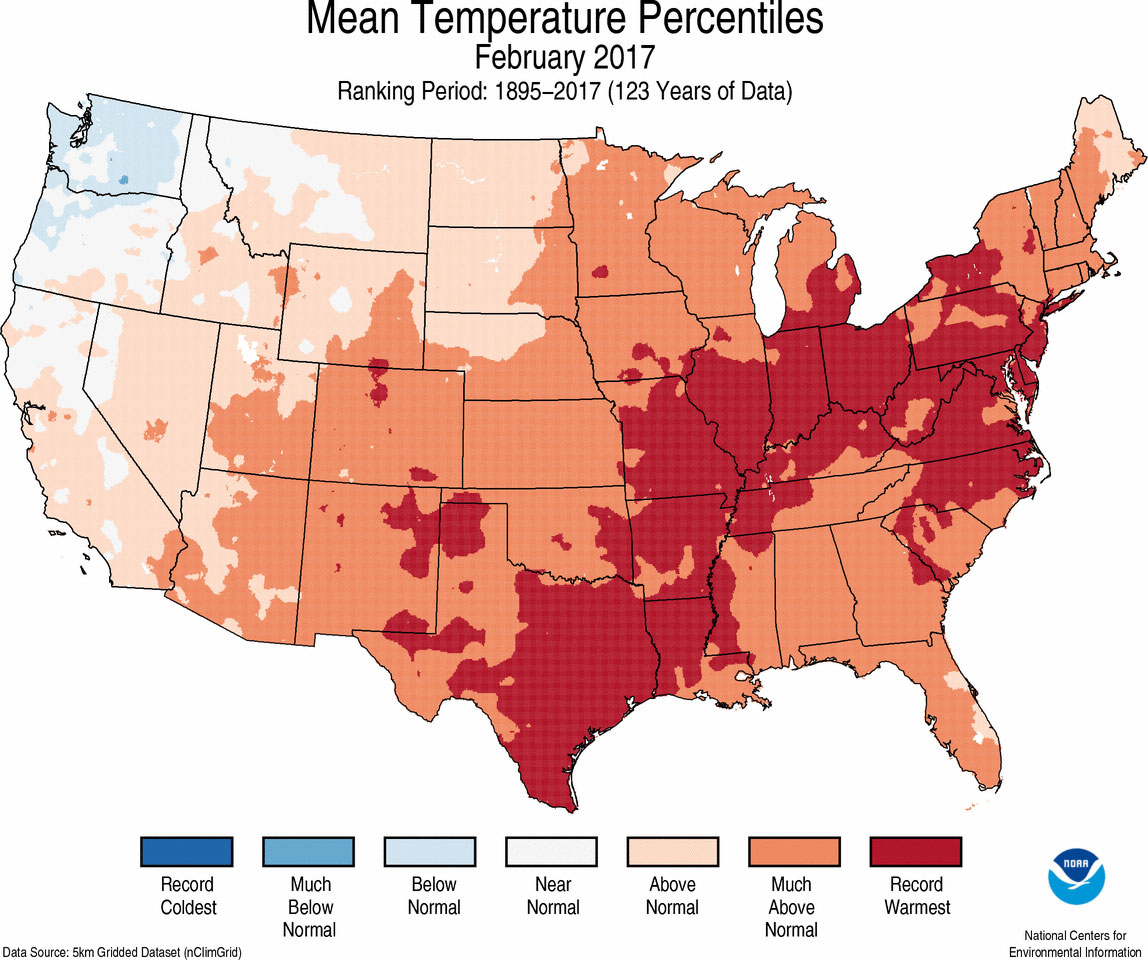
[Click image to enlarge]

Buffalo also broke a 111-year-old record for one day’s warmth. The city shattered the record for Feb. 24 when the temperature soared to 71 degrees, the all-time warmest day in February in Buffalo’s history.  On Feb. 26, 2000, the thermometer also crested to 71 degrees.

On average, Buffalo's normal daily high temperature doesn't reach 71 degrees until May 30, according to weather service data.

The monthly average temperature for February as recorded at the Buffalo Niagara International Airport was 34.8 degrees.

Buffalo had one of its least-snowiest Februarys on record, with only 5 inches of snow over the 28 days. February's normal monthly average is 17.3 inches.

Elsewhere, Chicago, a city that's also known for snowy days during the second month of the year, had no measurable snow in February. February 2017 will go into the record books as only the third February with just a trace of snow, joining 1998 and 1987.

Below is a map of the recent weather pattern for February 9-22 across the country posted at weather. com : 


The map indicates record warmth dominating the Eastern two-thirds of the country. More than 4000 heat records were broken. Also, an abundance of heavy rain ("atmospheric river" events) and snow (over 400 inches at ski resorts) fell along the West Coast. Flowers bloomed in the South. And closer to home, there was very little ice in the Great Lakes.

For the second consecutive year, mild winter weather conditions resulted in little to no ice cover on Lake Erie.

In the Buffalo area, the absence of snow cover and presence of warm temperatures on some days this February were suitable for people to play golf. 

While the warm winter temperatures are welcomed by many people, such unseasonal warmth can put area apple and cherry growers as well as grape growers on edge. When trees and vines begin budding early, and then are hit with cold weather and hard frost, the crop can be ruined.

Changes in the timing of spring can affect human health, bringing early-season disease-carriers such as ticks and mosquitoes, and an earlier, longer and more vigorous pollen season, the National Phenology Network warned.

But typical winter weather is definitely not over, and neither are strong winds.

Wind gusts over 35 mph have been recorded in Buffalo on more than one of every three days since Dec. 1, a Buffalo News analysis of National Weather Service data shows.  Only one winter season since 2009-10 has been windier: 2013-14.

A double whammy of wind and snow was recently forecast. For March 13 through March 15, a winter storm watch with heavy and blowing snow has been issued for much of Western New York.

[Click image to enlarge]  

Could the unusually warm and wacky winter weather patterns across the country be linked to global warming?  

We know that the planet continues to get warmer. 2016 record global warming beat the 2015 record which in turn beat the 2014 record, as documented previously. In fact, 16 of the 17 warmest years occurred in the consecutive years 2001 through 2016.

Climate scientists have repeatedly warned that, with global warming, we should "expect the unexpected" in terms of weather.  Higher global temperatures mean more energy in the weather systems of Earth. That energy along with a complex mix of ocean circulation, water evaporation & precipitation, and moving air masses combine to produce our everyday weather and long-term climate.

Higher global temperatures have changed the environment on Earth. Polar ice and glaciers are melting, oceans are warming and sea level is rising. Unprecedented droughts, deadly heat waves, destructive wildfires fed by heat and drought, and historic floods are all occurring more frequently.

 “All weather events are influenced by the changed environment,” says Kevin Trenberth, a climate researcher with the U.S. National Center for Atmospheric Research. 

As a result of the Paris Climate Agreement, virtually all nations of the world have begun to implement plans to curb global warming by reducing greenhouse gas emissions primarily from burning fossil fuels. But stable greenhouse gases like carbon dioxide, already in the air and oceans, will continue to raise global temperature and influence weather events for decades to come. The sooner the world acts in earnest to curb global warming, the better.

UPDATE - March 19, 2017 
Cold snap kills nearly half of cherry blossoms, pushing back peak bloom date 

Read the report at  The Washington Post 

3/14/2017 Cherry blossom buds are covered in ice after a snowstorm in DC. Susan Walsh/AP


Wednesday, November 26, 2014

U.S.-China Climate Accord -- Roundup of News and Opinions

US and China reach historic climate change deal, vow to cut emissions
By Matt Hoye and Holly Yan, CNN
updated 11:59 AM EST, Wed November 12, 2014

Beijing (CNN) -- In a historic climate change deal, U.S. President Barack Obama and Chinese President Xi Jinping announced both countries will curb their greenhouse gas emissions over the next two decades.

Under the agreement, the United States would cut its 2005 level of carbon emissions by 26-28% before the year 2025. China would peak its carbon emissions by 2030 and will also aim to get 20% of its energy from zero-carbon emission sources by the same year.

"As the world's two largest economies, energy consumers and emitters of greenhouse gases, we have a special responsibility to lead the global effort against climate change," Obama said Wednesday in a joint news conference with Xi.

The announcement marks the first time China has agreed to peak its carbon emissions, according to the White House. Xi is calling for "an energy revolution" that would include broad economic reforms addressing air pollution.

Game changer for global talks?

Obama, who was in Beijing for the Asia-Pacific Economic Cooperation (APEC) summit, said he hopes the deal will spur other nations to tackle climate change.

"We hope to encourage all major economies to be ambitious -- all countries, developing and developed -- to work across some of the old divides, so we can conclude a strong global climate agreement next year," Obama said.

Xi said both sides were committed to working toward the goals before the United Nations Climate Conference in Paris next year.

Read more at CNN.com


What Climate Scientists Have To Say About Obama’s Deal With China  
by Emily Atkin, Posted on November 12, 2014 at 3:25 pm

It didn’t take long after the U.S. and China announced a historic agreement to cut greenhouse gas emissions on Wednesday for the reactions to start pouring in. Democrats and climate hawks praised the deal as an important step forward in the battle against sea level rise, habitat degradation, and extreme weather. Republican leaders deemed it an economic disaster, a continuation of the so-called “war on coal.”

Policymakers aside, however, it is also important to note the reactions of the people who actually measure climate change and predict how it will impact humans in the future. What do they think about the deal? Is it enough to make a real difference in the fight against catastrophic global warming?

For the climate scientists ThinkProgress asked on Wednesday, the answer was a resounding yes, with a side of caution. Scientists confirmed that the announcement, which has China agreeing to cap its emissions by 2030 and the U.S. committing to a 26 percent reduction in carbon emissions by 2025, represented a huge first step toward building the kind of political cooperation needed to effectively combat a global problem.

“My take is that this is an historic agreement for a number of reasons, not the least of which is that we now have a good faith effort on the part of the planet’s two leading carbon emitters to work together to lower planet-warming greenhouse gas emissions,” said Michael Mann, director of the Earth System Science Center at Pennsylvania State University.

One of the main Republican-driven arguments against policies that fight climate change has been the mere fact that global warming is global — it can’t be solved by one country alone. The argument has manifested itself many times in our political discourse: Why should the U.S. implement climate policies if China isn’t doing it too? Why should the U.S. do anything if it’s not actually going to make a difference?

The argument is “very weak substantively” — China is still developing, while the U.S. is already developed — but it has been effective politically in preventing climate action in the United States, according to Paul Higgins, a climatologist and Director of the American Meteorological Society’s Policy Program. Now that Obama has sealed cooperation with China, Higgins said, that argument is essentially moot.

Read more at ThinkProgress.org


U.S.-China pact is an accord the planet needed
By Eugene Robinson, Opinion writer, November 13, 2014

The minute we glimpse a flicker of hope in the fight against climate change, Republicans in Congress announce their intention to snuff it out. Fortunately for the planet, it seems they can’t.

This week’s stunning announcement of a long-range agreement between the Obama administration and the Chinese government over carbon emissions is the best environmental news in years. Not to sound grandiose, it means the world still has a chance to save itself from unmitigated disaster.

The significance of the accord, which was doggedly pursued by Secretary of State John Kerry, is not just that the world’s biggest emitters of greenhouse gases have agreed to take action. China’s ambitious target of generating 20 percent of its energy from sources other than fossil fuels by 2030 promises massive investment and innovation — a huge boost for clean-energy technologies, with impact worldwide.

Pay no attention to the “Yes, but” chorus. It is true that China could have committed to an earlier date for carbon emissions to level off and should have set interim targets. It is true that meeting the new U.S. goals will be no trivial undertaking. It is also true that the multiplying smokestacks of India, the third-largest emitter, will continue to spew heat-trapping carbon at an unfettered pace — for now.

These caveats are overshadowed by the fact that the U.S.-China agreement has the impact of a defibrillator upon U.N.-sponsored international negotiations for a global climate treaty, which have been sputtering for years and were on the verge of flat-lining. The deal makes irrelevant the argument that the whole endeavor is pointless unless the world’s two biggest emitters — together responsible for about 40 percent of the carbon being pumped into the atmosphere — are willing to commit themselves.

That argument has also been used domestically by foes of President Obama’s science-based climate policy. But if you expected Tuesday’s earthshaking announcement to change the hyper-partisan U.S. debate, well, you don’t know much about today’s Republican Party.

Read more at WashingtonPost.com


Racing to the Top with China
By Michael Brune, Exec. Director, Sierra Club
November 12, 2014

What a difference a week makes. This morning we awoke to the news that President Obama and Secretary of State Kerry have negotiated a historic joint announcement on climate change and clean energy cooperation. Coming from the world's two largest economies and two biggest carbon emitters, the new targets set by President Obama and President Xi Jinping have put the international community on notice: It's time to put up or shut up.

Three major, overarching goals were announced: 
  •     The U.S. will cut its net greenhouse gas emissions to between 26 and 28 percent below 2005 levels by 2025.
  •     China will attempt to peak its CO2 emissions by 2030 (and possibly sooner).
  •     Also by 2030, China will increase the share of non-fossil fuel energy it uses to around 20 percent.
China's pledge to cap its emissions is momentous -- and should compel India and other developing nations to set their own ambitious targets. But the game changer in this announcement -- and an under-reported one at that -- is China's goal of producing 20 percent of its electricity from carbon-free sources by the end of the next decade. To accomplish that, China will need to install 800 to 1,000 gigawatts of energy with zero emissions by 2030 -- an amount almost equal to current total U.S. electricity generating capacity.

Such rapid clean-energy growth will accelerate a positive feedback loop. As China drives toward its goal, clean energy prices will continue to drop. Solar and wind are cheaper than fossil fuels in many places already; as prices plummet even further, the transition from dirty fuels will pick up speed, helping China, the U.S., and other countries meet and exceed their climate targets and save money in the process.

Read more at the Sierra Club Newsletter


Adam Zyglis, The Buffalo News


Weak climate change deal with China is at least a start toward averting disaster
EDITORIAL - The Buffalo News
on November 15, 2014 - 12:01 AM

The United States and China struck what may be a significant agreement this week on reducing emissions that are heating the Earth to dangerous levels.

Or they may have painted a pretty face on what is an otherwise very ugly canvas, hoping no one will notice.

The truth is today uncertain, but this much is fact: The two adversaries, which together produce about 45 percent of the world’s emissions of greenhouse gases, made a start on what is undoubtedly the single biggest environmental challenge of the 21st century. In that, alone, this counts as a significant step.

That is true even if the agreement has more loopholes than all of Albany’s ethics laws put together. It’s true because it counts as a start and it should lead to more significant action down the road. It may lead to nothing, it is true, but without a start – and one that includes the two most conspicuous polluters – nothing is all that is guaranteed.

Read more at BuffaloNews.com