Showing posts with label environment. Show all posts

Thursday, October 3, 2019

FORUM: NY State's Climate Leadership and Community Protection Act


This Forum is a solutions focused discussion where the audience will hear from policymakers, businesses, social justice advocates, environmentalists, academics, thought leaders and others as they take a deeper dive into the new legislation and what it means to achieving climate neutrality.

  The event is on October 17th from 6-7:30pm at the Jacobs School of Medicine and Biomedical Sciences in downtown Buffalo. Refreshments and a cash bar will be available at 5:30pm. 
 
Registration is mandatory. Please RSVP here:  

More information can be found at:  


Saturday, October 13, 2018

Public Meeting: Importance of Transit in Reducing Greenhouse Gas Emissions

Citizens for Regional Transit

Quarterly Public Meeting

The Importance of Transit for Meeting U.S. Target 
Greenhouse Gas Reductions and 
Ongoing Efforts to Meet Those Targets

Thursday, October 18
5:30 - 7:00 p.m. (doors open at 5:00)

Central Library
1 Lafayette Square, Buffalo
Central Meeting Room (upstairs)

PRESENTERS:
  • Bonnie Lawrence, Erie County Dept. of Environment & Planning
  • Doug Funke, Citizens for Regional Transit
  • TBD, Representative from the NFTA

FREE AND OPEN TO THE PUBLIC


Tuesday, October 9, 2018

Rep. Higgins to Introduce McMurray at Endorsed Candidate Event

The Sierra Club Niagara Group is holding an Endorsed Challengers Meet & Greet Rally which will be FREE and open to the general public. This is an opportunity to hear each candidate briefly describe his/her platform and their views on a variety of environmental topics.

As a highlight of the event, Congress Member Brian M. Higgins has been confirmed to introduce candidate Nate McMurray, who is running for U.S. Congressional District 27.


Friday, October 12, 5pm-7pm, UAW Region 9 Hall, 35 George Karl Blvd, #100 (just off Wehrle Drive, near Transit), Williamsville, NY  [Map]

Besides meeting the candidates, attendees will have an opportunity to donate money and/or volunteer for those campaigns which they choose to support. FREE food and beverages will be available.

Turnout in New York’s September 13th primary was almost triple that of the 2014 primary for governor.  Interest in this year’s elections is sky high with both the U.S. House of Representatives and the NY State Senate in play.  Excitement is building and a big crowd is expected for this event.

Candidates who will be featured at the Meet & Greet Rally are listed below.

Name                                      Race

Nate McMurray                       (US Congress, District 27)

Joan Elizabeth Seamans       (NY Senate, District 61)

Carima El-Behairy                   (NY Senate, District 60)

Karen McMahon                     (NY Assembly, District 146)

Patrick Burke                          (NY Assembly, District 142)

Michelle Roman                      (Mayor of Lockport)

Luke Wochensky                    (NY Assembly, District 147)


Watch this Video shared by Bill Nowak:
(After opening the link, click the Speaker symbol to hear the sound)

Wednesday, January 25, 2017

Nationwide Protests 'Inspiring' and must keep 'Moving Forward' to Protect Our Democracy, says Author

Democracy & Government                 

A Great and Joyful March, But It’s Not Enough

Saturday's protests were inspiring but just the first step in fighting back against those who would end democracy.


 Thousands of people take part in the Women's March on Jan. 21, 2017 in New York City. The midtown Manhattan event was one of many anti-Trump protests nationwide that came a day after Donald Trump was sworn in as the 45th President of the United States. (Photo by John Moore/Getty Images)

“Peaceful protests are a hallmark of our democracy. Even if I don’t always agree, I recognize the rights of people to express their views.”

On Sunday morning, that came flying out from the Twitter account of @realDonaldTrump, raising the question, “What have you done with the real, @realDonaldTrump?”

It sure didn’t sound like the troll we’ve come to know. A couple of days in, maybe the awesomeness of becoming the leader of the free world had penetrated his roiling psyche and settled him down.

Nah. Clearly, he hadn’t written it. Because just two hours before, in a tone far more like the narcissistic whinge we’re used to, the Trump account tweeted, “Watched protests yesterday but was under the impression that we just had an election! Why didn’t these people vote? Celebs hurt cause badly.”

Not voting? Celebs? That sound you heard was my cognitive dissonance alarm hitting DEFCON 1.

In both instances, the bad and not-quite-as-bad Trump personas were writing about Saturday’s worldwide protests, women’s marches in more than 500 cities in the United States — at least 3.7 million Americans — and more than another hundred demonstrations internationally, from London and Paris to that handful of hearty souls who displayed their protest signs in Antarctica.

There were half a million people in Washington, DC, just the day after the less-than-superb turnout for Donald Trump’s inauguration and some 400,000 here in New York City, if not more. According to Sarah Frostenson at Vox, “… Political scientists say they think we may have witnessed the largest day of demonstrations in American history.”

I have been at many, many protest marches in my life, going back to the big anti-Vietnam demonstrations of the late ’60s and ’70s, and I have never experienced anything like what happened this weekend. We arrived at our designated stepping off point on Saturday at 11:30 a.m., right on time, but the block was so packed it already had been penned off. A marshal suggested we move up to the next street above and work our way back down to where we were supposed to be but it was impossible and in the process I managed to get separated from my friends — too much of a crowd between us to get back to one another; a situation complicated by a dying cellphone.

A scene from the crowd in the march in New York on Saturday, Jan. 21, 2017. (Photo by Michael Winship)
A scene from the crowd in the march in New York on Saturday, 
Jan. 21, 2017. (Photo by Michael Winship)
And so there I stood, alone in the crowd, waiting for something to happen, soaking in the excitement and anticipation everyone shared at being there, enjoying the collegiality, reading the hundreds of signs, from the woman carrying a 5×7 card with the words, “A tiny sign for a tiny man” to the guy not far from me whose placard read, “A woman made this sign for me.”

Apparently, our numbers were so unexpected it took a while for the organizers and police to figure out what to do with us all, so it was 2:30 p.m. or so before we finally began to move, slowly swinging south onto Second Avenue on the east side of Manhattan. This wasn’t so much a march as a slow group shuffle; there were so many people crowded onto the street we could only move a little bit at a time, like an escaped chain gang bound at the ankles.

We worked our way down to 42nd Street and then west. I was tempted to peel off at Grand Central Station and head home — the hour already was late — but I was determined to make it all the way to the end, to reach Fifth Avenue and 56th Street and summit at Trump Tower.

By the time we made our way onto Fifth Avenue the sun was going down but we kept moving, singing, chanting, cheering. A 6-year-old girl, perched on a grown-up’s shoulders, urged us on: “We are the popular vote! This is what democracy looks like!” she shouted and we echoed everything she said. This was her personal favorite: “Donald Duck for president!”

Saturday was a stunning affirmation of defiance, a rebuke and warning that resistance has just begun, yet only if we have the patience and grit to keep it moving forward.

We got to a block from Trump’s gilded pleasure dome and then were turned away by parade marshals
and police. We could get no closer; barriers blockaded the way. Amicably, the protesters broke up, walking east and west on the cross streets, many filling the bars and restaurants, others crowding into the subway stations, headed home.

White House press secretary Sean Spicer tried to shrug off the significance of what happened on our streets Saturday. Referring to the Washington march, he said, “There were people who came to the Mall, as they do all the time, sometimes in smaller numbers.” Ho-hum, he seemed to say.

“A lot of these people were there to protest an issue of concern to them and not against anything,” Spicer said, personifying the self-deception that believes the lie.

Sorry, Sean — Saturday was a stunning affirmation of defiance, a rebuke and warning that resistance has just begun, yet only if we have the patience and grit to keep it moving forward.

I’ve told this story here before, but the lesson remains: In the wake of the murder of protesting students at Kent State and Jackson State in 1970, the big antiwar demonstrations that followed and the nationwide student strike that shut down hundreds of colleges and universities, the idea was not just to demonstrate but to mobilize and continue to work toward an end to the Vietnam War. Once the dramatic marches had come to an end, all too many simply took advantage of an early end to the semester and headed for the beach. Little was accomplished and the war continued for another five years. Those of us who wanted to keep the peace work going — the stated intention of the strike — were met with diffidence at best and at worst, outright apathy and resentment.

“Thank you for understanding that sometimes we must put our bodies where our beliefs are,” Gloria Steinem said at Saturday’s rally in Washington. “Pressing ‘send’ is not enough.” She’s right, but marching won’t be enough either as we go up against a committed band of zealots determined to end all remaining vestiges of the New Deal and the Great Society and to further enrich the wealth of the 1 percent — especially, of course, themselves.

“This is the upside of the downside,” Steinem said on Saturday. “This is an outpouring of energy, and true democracy like I have never seen in my very long life. It is wide in age, it is deep in diversity, and remember, the Constitution does not begin with ‘I the president,’ it begins with ‘we the people.’”

The work must take place at every level, from local on up: organizing, keeping yourself informed,
sending letters and emails, making phone calls, attending town meetings, running for office or working for the candidates who best represent your interests.

And this, perhaps above all: confront your member of Congress. Don’t let him or her off the hook. Make sure your representative doesn’t sell you out to the Big Interests, or deceive you with empty rhetoric. If they do – throw the rascals out.

There is no time to lose. With each day, a cornice of our republic crumbles and the body of democracy struggles to keep itself from stumbling and falling into the abyss. No joke.

Sunday, November 20, 2016

SUSTAINABILITY: Business Will Move Ahead on Environmental and Social Issues, Independent of U.S. Political Leadership

Sustainable Business Will Move Ahead With or Without Trump’s Support


Harvard Business Review | November 18, 2016

Andrew Winston is the author, most recently, of The Big Pivot. He is also the co-author of the best-seller Green to Gold and the author of Green Recovery. He advises some of the world’s leading companies on how they can navigate and profit from environmental and social challenges.

If we take the incoming president of the United States at his word, things look dire for the cause of sustainability. Donald Trump and many of his advisers appear hostile to action on climate change and to progress on many social issues that companies have already embraced, such as diversity and LGBT rights. Even if Trump himself stays ambivalent on some of these issues, Republican leaders have much clearer aims, including extensive plans to slash environmental protections.

Will the seismic shift in U.S. political leadership have a chilling effect on corporate action around environmental and social issues? The short answer is no. Companies will continue to pursue sustainability in the United States because the macro forces driving the movement remain strong. The big trends didn’t disappear on election day and, more important, they do not depend on the U.S. government. Let’s unpack what’s really been propelling most companies forward, which comes down to five megatrends.

The Economics of Clean Tech

In short, Trump cannot stop all momentum on the clean economy. The economics are too good. The cost to build and produce solar and wind power, for example, has dropped 60%–80% since 2010, making it cheaper than grid electricity in most states. And, most critical, this economic reality holds even without subsidies. Of course, government aid is helping accelerate the transition, but given the economic boost that clean energy provides to many states, support for wind and solar looks relatively safe in Congress. GOP Senator Chuck Grassley said that if Trump tries to eliminate the wind tax credit, the president-elect will “do it over my dead body.”

A Changing Climate

I’m not talking about the politics of and governmental action on climate change, such as the Paris Accord, carbon trading schemes, or efficiency standards. I mean actual extreme weather and climate change. These things are not theoretical and are costing business and society today. When Kellogg’s CEO, John Bryant, spoke at the Paris meeting, in December 2015, he told the assembled executives and diplomats that addressing climate change was “mission critical” for the company. (I was onstage with him and heard it very clearly.) One of his reasons why is what he described as a “fragile supply chain,” wherein weather shocks can damage grain production — a nice way of saying we don’t know if we can grow enough food. Across other sectors, unprecedented floods and storms around the world have done many billions of dollars of damage to factories, distribution centers, and local economies.

More companies are recognizing climate’s systemic risks. A week before the election, the CEO of General Mills, Ken Powell, spoke about his commitment to acting on climate. He put it in simple, CEO-friendly terms: “I am accountable for enterprise risk,” he said, “and clearly there’s a strong scientific consensus that climate is a risk.” For these reasons and more, hundreds of U.S. CEOs signed a letter to the president-elect that urged him to stay the course on global climate action and building the clean economy.

The Demands of Millennials

They are, after all, the largest generation on the planet and will make up 50% of the global workforce by 2020. On average, they hold some starkly different views about business than their predecessors did. A global survey of these 20- and 30-somethings earlier this year showed that 87% believe “the success of a business should be measured in terms of more than just its financial performance.” A Morgan Stanley survey confirmed that Millennials, and particularly those who are active investors, are three times as likely to seek employment with a company that cares about social and environmental issues. The jury is still out on whether this group will shop differently as it gets richer and deeper into adulthood, but every company I work with is feeling pressure from younger workers. In their role as employees, Millennials clearly want sustainability.

Radical Transparency and Social Media

We’re all growing accustomed to finding any information we want at any time. This includes wanting to know what’s in everything we buy, how it was made, who made it, and so on. The food and consumer products sectors are feeling this megatrend most acutely. The “clean label” movement is shaking up these industries, forcing companies to reduce ingredients and use fewer processed and artificial inputs. As General Mills’ Powell said, consumer expectations “have never been higher.”

Turbocharging this trend is social media, with which people can gather, spread stories, and generally make a company miserable if it doesn’t have its act together. In essence, as one CEO of a consumer-facing Fortune 50 company told me, customers can destroy your brand on Twitter (I’m paraphrasing only slightly). As he put it, products can’t just taste or look good — they have to tell a story and prove that they’re “responsibly sourced, manufactured, and distributed.” This shift in expectations is driving companies to understand their supply chains better, which then translates into pressure on those companies to aggressively manage their environmental and social issues.

Global Commitment and Competitive Pressure

Multinationals operate in many countries where governments publicly support strong action on climate — and 193 countries in the world signed the Paris Accord. It’s hard to say what will happen to that agreement, but even uncertainty about the commitment of the United States likely will not sink it. All of the signatories are meeting right now at the UN climate change conference in Morocco, and they’re making it clear that they are powering on. China sent a message publicly that climate change is no hoax, and France’s President Sarkozy mused about imposing import tariffs on countries that don’t “respect the rules” on carbon reduction. In essence, companies that don’t continue the sustainability journey are going to fall behind and become uncompetitive in global markets.

On top of all these megatrends is incredible innovation, making solutions to our challenges cheaper and more accessible. But even without those technological shifts, the five megatrends here create an overwhelming case to continue the sustainability journey. The bottom line is, as always, the bottom line. The business case for sustainability has been proved over and over again. The companies managing their environmental and social issues and helping their customers navigate these issues are creating business value in multiple ways: They’re saving money, driving innovation, attracting talent, and building the brand. None of that has changed, and there’s still tremendous value to unlock. Sustainability has never been solely about government pressure anyway — it’s just good for business.

All of this optimism aside, it would be naïve to think that the president of the United States can’t affect the course of progress toward a clean, sustainable world. And while we can’t know exactly what the next administration will do, that it will not be driving sustainability is a safe assumption. So business has a critical role now more than ever to make up for the headwinds that a hostile administration can generate.

Businesses will need to ensure the stability of the basic underpinnings of a thriving economy and society — that is, clean air and water, a stable climate, abundant and renewable natural resources, an educated and engaged pool of talent, robust global and local markets filled with people with enough wealth to buy your products, and much more.

If the new administration does not protect or enhance those pillars of a strong economy, or even actively undermines them, then business must take action, make up for the slack, and render federal action irrelevant. If government is derelict in its duties, business has to lead.

Follow Andrew Winston on Twitter @AndrewWinston

Saturday, April 2, 2016

Communal Forum on the Environment


Congregation Shir Shalom, 4660 Sheridan Dr., Williamsville 

716-633-8877

Open to the public

Click here to view the flyer
 

Thursday, December 10, 2015

NY Renews - A Climate Justice and Jobs Campaign - Dec.16 Launch Party

On December 16, 2015, leaders and members of labor, community, and environmental organizations across New York State will unite to launch a climate justice and jobs campaign - NY Renews - that aims to win progressive policy reform in the 2016 NYS legislative session and beyond.

The NY Renews platform contains three planks that each respond to the needs and interests of the campaign's core constituencies.

It calls for mandatory and legally enforceable greenhouse gas emission reduction and renewable energy procurement goals that match a set of aspirational goals already adopted in the 2015 NYS Energy Plan and carried forward in the Reforming the Energy Vision regulatory initiative. These goals include 80% emission reductions by 2050 (from 1990 levels), with an interim goal of 40% by 2030; and a clear path to 100% renewable energy procurement, with an interim goal of 50% renewable energy procurement by 2030.

The platform calls for the creation of a reinvestment fund targeted to low-income communities, and environmental justice and climate vulnerable communities across the state, and mandates that 40% of existing public funds collected by NYSERDA be allocated to targeted communities for purposes of renewable energy and energy efficiency reinvestment and local job creation.

The third plank of the platform calls for mandatory job standards on publicly supported projects and direct financial support to workers and communities caught in the transition from dirty energy to renewable energy. Workers would receive re-training and retirement support and communities would receive revenue support to offset diminishing tax revenues from industries in transition.

UPDATE Dec. 16, 2015: TimesUnion - Coalition launches campaign to make NY climate leader

[Click image to enlarge]      
The launch event in Buffalo - 'Party for the Climate!' - will take place at the Tralf Music Hall from 6:00pm to 9:00pm on December 16. Its a free, all-ages event (under-21 must be accompanied by a parent or guardian). A cash bar and food will be provided. With support from Ujima Theatre Company, we've booked a couple of local musical powerhouses - the 16-piece Buffalo Afrobeat Orchestra and DJ Milk - to keep the energy high and bring people together. This event will reveal - through the voices of local labor, community, and environmental leaders - our unity of purpose and showcase our collective power.

Click Here to Join the Facebook Event

The NY Renews campaign will kick into high gear in early 2016 so your organizational support for the campaign and participation in the event are critical. Join us! 

Sunday, October 18, 2015

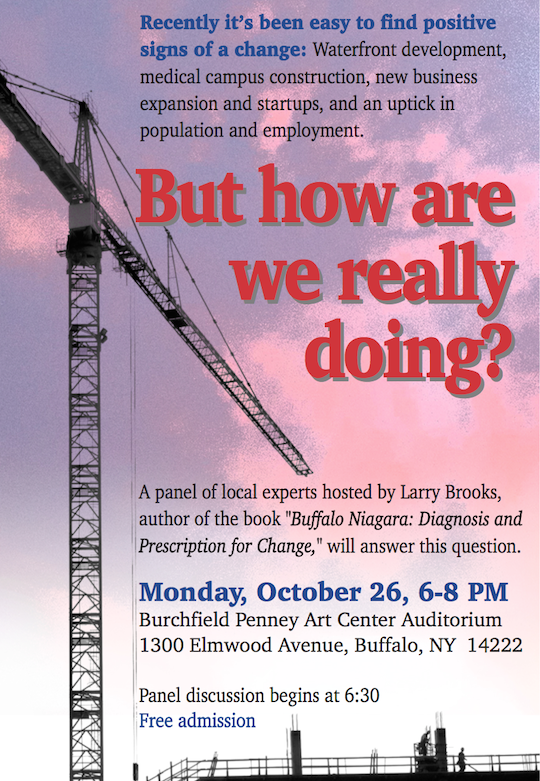
Panel Discussion: How is Buffalo Niagara really doing?


Buffalo Niagara: How Are We Really Doing?
A panel of local experts will answer this question. The panel will be hosted by Larry Brooks, author of the new book Buffalo Niagara: Diagnosis and Prescription for Change.

The panel includes:
  • Philip Haberstro, Executive Director, Wellness Institute of Greater Buffalo & WNY
  • Jay Burney, Founder and Chair, Friends of Times Beach Nature Preserve
  • Sam Magavern, Co-director, Partnership for the Public Good
  • Marlies Wesolowski, Executive director, Lt. Col Matt Urban Human Services Center

Friday, October 9, 2015

Film: THE WISDOM TO SURVIVE - Climate Change, Capitalism & Community

Join Us for the Buffalo Premier of the Film

Hosted by the Buffalo Zen Dharma Community

in support of the

Rise Up for Climate Justice Campaign

MAP to the Event Site: Click Here

View the Film Trailer: 

Tuesday, September 15, 2015

Citizen Science Workshop on Pollution to be held in Tonawanda

A daylong citizen science workshop and conference on environmental pollution will be held Saturday in the Sheridan Parkside Community Center, 169 Sheridan Parkside Drive, Town of Tonawanda.

The free workshop begins at 9:30 a.m. with breakfast, continues at 10 a.m. with speaker presentations and concludes at 5 p.m.

Participants will learn how citizens used scientific data to hold Tonawanda Coke accountable for pollution, and how to use monitoring tools to test their own air, soil and water. Residents can bring a small bag of soil to have it tested for the presence of heavy metals. Updates on civil and federal actions taken against Tonawanda Coke will also be given.

A bus tour of toxic sites in Western New York is scheduled from 3:45 until 9 p.m. Friday. Registration is required.

For more information, visit airhugger.org, call 873-6191 or email info@csresources.org. The workshop is organized by Citizen Science Community Resources and Global Community Monitor.


Thursday, July 2, 2015

TALK: Pope's Climate Encyclical 'On The Care of Our Common Home'

The Sierra Club
Climate and Clean Energy Writers Group
Monday, July 6th, 2015 Session:

Haven't had time to read the

Pope’s Climate Encyclical?

Come hear what Sister Eileen O'Connor has to say.

pope

Find links to these inspiring published writings on Sierra Club's

Writer’s Group – In the News page.

~  ~  ~

NiagaraSierraClub.com

Monday, April 27, 2015

How do You like Your Water -- With or Without Plastic Microbeads?

By David Kowalski .

Microbeads are tiny plastic spheres that are widely used in cosmetics and skin care products as exfoliating agents.

When products containing the microbeads are washed down the drain, they enter the sewage system. However, the microbeads are not filtered out by sewage treatment and so they enter our waterways.

Initially found in open waters of Lake Erie, microbeads have subsequently been detected in water of Lake Ontario, Cayuga Lake, Oneida Lake, the Erie Canal and elsewhere. Microbeads were recently found in the Adirondack Region in Lake Placid wastewater.

A study just released by the NY State Attorney General's Office found microbeads in wastewater discharged from 74% of the treatment facilities tested. The true contribution of microplastic pollution is likely greater than that detected since only the easily-identified types of microbeads (spherical and speckled - only 6% of the total types) were studied.

[Click image to enlarge]
Microbeads in the water are consumed by fish, other wildlife and ultimately by humans.

Fredonia State College professor, Sheri Mason, has researched microbead pollution in the Great Lakes. Mason says that the plasticizer chemical present in the plastic is the concern because it can move out of the plastic and into you.

Certain plasticizer chemicals may interfere with the body’s endocrine system and produce adverse developmental, reproductive, neurological, and immune effects.

Another important concern is microbead absorption and concentration of toxic chemical pollutants present in waterways. This could harm fish and other marine life that mistake the toxic microbeads as food. Fish that bioacumulate the concentrated toxins over time may cause harm to birds, pets or people that eat them.

The New York State Legislature needs to back a bill to eliminate microbeads to protect our environment and public health. The Assembly has already passed a bill to prohibit the sale of personal cosmetic products containing microbeads.

The Senate bill (S3932-2015) has been referred to the Environmental Conservation Committee. Unfortunately, there was insufficient support to bring that bill up for a vote last year.

Public support is absolutely necessary to move the Senate bill out of the Committee and to the floor for a vote.

Take Action - Contact your NYS Senator
Urge them to Co-sponsor Bill S3932-2015, the "Microbead-free waters act," to prohibit sale of personal cosmetic products containing microbeads.

Senate Directory and Identity:
- For phone numbers and to contact by Email, visit: http://www.nysenate.gov/senators

- To identify your Senator, go here: http://www.elections.ny.gov/district-map/district-map.html


Buffalo News Editorial cartoon by Pulitzer Prize Winner Adam Zyglis
This post was updated on 4/28/2015.

Monday, November 18, 2013

Energy Debate: Shale vs. Renewable

On Tuesday, November 19, from 12 noon to 1 PM on Buffalo's WUFO-AM 1080
radio, host Jim Anderson will interview Chris Faulkner, CEO of Breitling Oil and Gas.

The privately-held Dallas Texas based company extracts oil and gas from North Dakota's Bakken Shale, Texas' Eagle Ford Shale, the Marcellus Shale, and several other shale plays.

Accompanying Jim Anderson will be:
  • Lynda Schneekoth, Chair, Sierra Club-Niagara Group
  • Robert Ciesielski, Chair, Sierra Club-Niagara Group's Energy Committee
  • Rita Yelda, Organizer, Food and Water Watch
  • Charley Bowman, Chair, Renewable Energy Task Force of the WNY Peace Center.

Listeners with questions/comments can call: 716-837-1112
Folks outside WUFO's range can listen to the debate Online at:http://streema.com/radios/WUFO


Saturday, October 26, 2013

Wendell Berry - Visionary, Author, Farmer, Activist

Introduction and Video from Moyers & Company.

 Wendell Berry, a quiet and humble man, has become an outspoken advocate for revolution. He urges immediate action as he mourns how America has turned its back on the land and rejected Jeffersonian principles of respect for the environment and sustainable agriculture. In a rare television interview (video, below), this visionary, author, and farmer discusses a sensible, but no-compromise plan to save the Earth.

Bill Moyers profiles Berry, a man of the land and one of America’s most influential writers. Berry's prolific career includes more than forty books of poetry, novels, short stories and essays. The interview was taped in Kentucky during a conference celebrating Wendell Berry’s life and ideas and marking the 35th anniversary of the publication of his landmark book, The Unsettling of America.

Berry lives and works on the Kentucky farm where his family has tilled the soil for 200 years. He’s a man of action as well as words. In 2011, he joined a four-day sit-in at the Kentucky governor’s office to protest mountaintop mining, a brutally destructive method of extracting coal.

Moyers explores Berry’s views on civil disobedience as well as his strong opposition to agribusiness and massive industrial farms. They also discuss Berry’s support for sustainable farming and the local food movement.

“My belief is that the world and our life in it are conditional gifts,” Berry tells Moyers. “We have the world to live in on the condition that we will take good care of it. And to take good care of it we have to know it. And to know it and to be willing to take care of it, we have to love it.”

Monday, January 21, 2013

COMMUNITY FORUM: Regional Vision and Values - Where Do We Want to Go?

Please join us and our partners as we launch One Region Forward, a new effort seeking to coordinate our region’s efforts towards creating a more sustainable economy, environment and community.
The creative contribution and informed support of the citizens of the Buffalo Niagara region is critical and we need to hear your voices as we chart this course.                                                                                                         
To learn how you can get involved and share your thoughts on the vision and values that should guide this effort, please join us at one of our two “Community Congress” meetings scheduled over the next few weeks.

If you are interested, please sign up to participate for one of the two events listed below:
*January 29th, 7-9pm, Asbury Church
http://www.oneregionforward.org/event/community-congress-1-erie-county/
*February 2nd, 2-4pm, Niagara Falls Conference Center
http://www.oneregionforward.org/event/community-congress-2-niagara-county/

To learn more about the project, check out our website at www.oneregionforward.org.

Thursday, December 20, 2012

Should U.S. Expand Fracking to Export Shale Gas?

Critics cite need for information on impacts of expanded shale gas production on human health, communities, environment and domestic prices.   

Doctors Urge U.S. to Block Gas Export Terminals
By Jon Hurdle

More than 100 physicians urged the Obama administration on Thursday not to approve the construction of liquefied natural gas [LNG] export terminals until more is known about the health effects of hydraulic fracturing, the drilling process that has opened the way for a big increase in domestic gas production.

Until policymakers and public health officials determine whether fracking is dangerous to human health, they argue, the government should not allow the development of the 15 new export terminals that have been proposed by the gas industry. The government has so far approved one export terminal, proposed by Cheniere Energy, in Louisiana.

The demand for exports has risen from a recent boom in domestic production resulting from the use of fracking in combination with horizontal drilling, which has allowed the industry to exploit vast shale gas reserves at an affordable cost. Energy companies are also lured by sharply higher natural gas prices overseas.

Link to the full article at the New York Times Green Blog.


Why Policymakers and the Public Need Fair Disclosure Before Exports of Fracked Gas Start
By Craig Segall, Staff Attorney, Sierra Club Environmental Law Program.

Exporting American Liquefied Natural Gas [LNG] to the world market would spur unconventional natural gas production across the country, increasing pollution and disrupting landscapes and communities. Deciding whether to move forward is among the most pressing environmental and energy policy decisions facing the nation. Yet, as the Department of Energy (DOE) considers whether to greenlight gas exports of as much as 45% of current U.S. gas production — more gas than the entire domestic power industry burns in a year — it has refused to disclose, or even acknowledge, the environmental consequences of its decisions.

Gas exports would transform the energy landscape and communities across the country. We owe ourselves an open national conversation to test whether they are in the public interest. We need to look before we leap.

Download the Sierra Club report here (44 page PDF).

Wednesday, June 20, 2012

Shale Gas Drillers Fail to Comply with Regulations Protecting Health and Environment

The PennEnvironment Research & Policy Center released a report  entitled "Risky Business: An Analysis of Marcellus Shale Gas Drilling Violations in Pennsylvania 2008-2011" on February 8, 2012.

Using records obtained by the Pennsylvania Department of Environmental Protection (PADEP), the Center identified a total of 3,355 violations of environmental laws by 64 different Marcellus Shale gas drilling companies between January 1, 2008 and December 31, 2011.  Of these violations, the Center identified 2,392 violations that likely posed a direct threat to our environment. These were not reporting or paperwork violations. 


Moreover, the PennEnvironment Research and Policy Center believes these numbers offer a conservative view of environmental violations taking place across the Pennsylvania by Marcellus Shale gas drilling companies. These data only include violations discovered by PADEP’s enforcement staff. Yet based upon the number of wells drilled and limited PADEP enforcement staff, further violations that have gone undetected are likely.

The greatest numbers of environmental violations were related to improper erosion and sedimentation plans: 625 (26% of all violations likely to impact the environment). The second greatest number involved faulty pollution prevention techniques: 550 (23% of violations likely to impact the environment).

Between 2008 and 2011, on average, Pennsylvania saw more than two violations per day uncovered by PADEP, roughly 1.5 of which had the greatest potential to impact the environment.

PennEnvironment Research and Policy Center identified 963 violations (29% of all violations) that seemed less likely to directly endanger the environment or the safety of communities. Their report focuses on the violations that have the greatest potential for directly impacting Pennsylvania’s environment.

The report concludes that "Marcellus Shale gas drilling companies are either unable or unwilling to comply with basic environmental laws that have been put in place to protect the health and environment of Pennsylvanians."

PennEnvironment Research and Policy Center recommends in the report that "certain policy handles must be implemented in order to stop the rampant rate of environmental violations that drilling companies commit in Pennsylvania each year."

Visit the PENN Environment Web site to download the report and to see information about the author and sources of foundation support. 

Commentary ~ by David Kowalski 
It's interesting to compare the PENN Environment results with those in a new report by the University at Buffalo (UB) Shale Resources and Society Institute (SRSI). The latter report is entitled "Environmental Impacts during Marcellus Shale Gas Drilling: Causes, Impacts and Remedies" (released May 15, 2012 and revised June 6, 2012). Both reports analyzed PADEP data but they arrived at very different conclusions.