Showing posts with label sea-level rise. Show all posts

Friday, June 28, 2019

Climate Crisis is Our Third World War -- Requires a Bold Response

The climate crisis is our third world war. It needs a bold response

Joseph Stiglitz | June 4, 2019 | The Guardian

Critics of the Green New Deal ask if we can afford it. 
But we can’t afford not to: our civilization is at stake.


Advocates of the Green New Deal say there is great urgency in dealing with the climate crisis and highlight the scale and scope of what is required to combat it. They are right. They use the term “New Deal” to evoke the massive response by Franklin Delano Roosevelt and the United States government to the Great Depression. An even better analogy would be the country’s mobilization to fight World War II.

Critics ask, “Can we afford it?” and complain that Green New Deal proponents confound the fight to preserve the planet, to which all right-minded individuals should agree, with a more controversial agenda for societal transformation. On both accounts the critics are wrong.

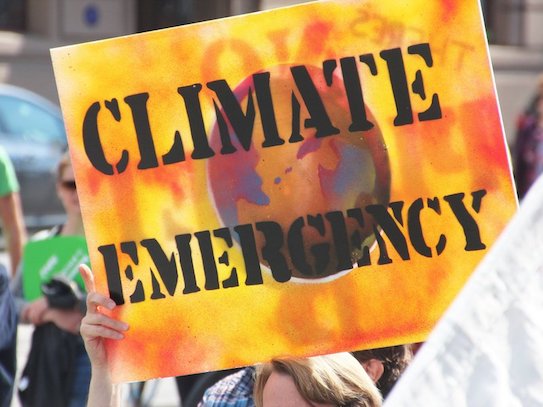
Yes, we can afford it, with the right fiscal policies and collective will. But more importantly, we must afford it. The climate emergency is our third world war. Our lives and civilization as we know it are at stake, just as they were in the second world war.

When the US was attacked during the second world war no one asked, “Can we afford to fight the war?” It was an existential matter. We could not afford not to fight it. The same goes for the climate crisis. Here, we are already experiencing the direct costs of ignoring the issue – in recent years the country has lost almost 2% of GDP in weather-related disasters, which include floods, hurricanes, and forest fires. The cost to our health from climate-related diseases is just being tabulated, but it, too, will run into the tens of billions of dollars – not to mention the as-yet-uncounted number of lives lost. We will pay for climate breakdown one way or another, so it makes sense to spend money now to reduce emissions rather than wait until later to pay a lot more for the consequences – not just from weather but also from rising sea levels. It’s a cliche, but it’s true: an ounce of prevention is worth a pound of cure.

The war on the climate emergency, if correctly waged, would actually be good for the economy – just as the second world war set the stage for America’s golden economic era , with the fastest rate of growth in its history amidst shared prosperity. The Green New Deal would stimulate demand, ensuring that all available resources were used; and the transition to the green economy would likely usher in a new boom. Trump’s focus on the industries of the past, like coal, is strangling the much more sensible move to wind and solar power. More jobs by far will be created in renewable energy than will be lost in coal.

Read more at The Guardian

Joseph E Stiglitz is a university professor at Columbia, the 2001 recipient of the Nobel Memorial Prize in Economics, a former chairman of the Council of Economic Advisers, a former chief economist of the World Bank and the author, most recently, of People, Power, and Profits: Progressive Capitalism for an Age of Discontent
~    ~    ~

Wednesday, January 24, 2018

Naomi Klein, Author & Activist: Polluting Industries, Climate Disruption and Justice


Speech by Naomi Klein
delivered on the day of the historic announcement that New York City is divesting from fossil fuels and suing five oil majors who knowingly deepened the climate crisis.

For a very long time, our movements have been insisting that principles of justice need to be at the center of the response to the climate crisis – a crisis that plays out in the most perversely unjust ways right now.

Justice means that people who did the least to create this crisis but are bearing the heaviest risks and most toxic burdens need to be first to benefit from green economic development and job creation.

Justice also means that workers in polluting industries are not sacrificed or left behind. And justice means something else too, something most politicians are loath to talk about because the wealth and power of fossil fuel companies is so vast.

It means that the corporate interests that did the most to get us into this mess – with their pollution and with their campaigns of wilful misinformation – are going to have to pay their true share of the tremendous costs of climate disruption, and of delayed transition. Because right now we have it upside down and backwards.

As it stands, the costs of sea level rise and ferocious and unprecedented weather events are offloaded on to the public, with taxpayers stiffed with the ballooning bills. And as governments absorb these costs, there is less money for schools, for affordable transit and housing, for health care. And, in yet another bitter irony, this hurts the people who are already impacted by climate change the most.

This city saw all this in dramatic fashion during Sandy, when it was the people in public housing who were left for weeks in the cold and dark.

Meanwhile, the extravagant profits from destabilizing our planet’s life support system, earned from ignoring and suppressing the scientific consensus – well, those are systematically privatized.

Earlier this decade, ExxonMobil alone made $45 billion in profits in a single year– more than any company in history. Enough to pay Rex Tillerson, then its CEO $100,000 a day.

In short, the status quo means the poor are paying again and again for the polluters to get even richer. It’s a world upside down. But that starts to change today.

By suing these five oil majors who knowingly deepened the climate crisis, and simultaneously beginning the process of divesting $5-billion from fossil fuel companies, New York City is taking a game changing first step in turning the world right side up. And not to overstate the case, but I actually think this could change the world.

There have been lawsuits before that have tried to sue the fossil fuel giants for climate damages. The tiny Arctic community of Kivalina, population 383, which attempted to recover the costs of having to relocate. Some citizens of the low-lying Pacific Island of Vanuatu– population 300,000 – that began a similar suit. A lone Peruvian farmer, suing a German coal giant for the risks to his home. A small group of Gulf Coast Mississippi homeowners, with the help of a scrappy lawyer, who tried to sue the fossil fuel companies after Hurricane Katrina.

These have been valiant attempts, but in every case, the industry has relied on the relative weakness and poverty of its accusers, sometime managing to quash suits before they were filed.

And that is why today’s news is so historic. Because bullying isn’t going to work here the way it has in the past. This lawsuit is coming from the largest city in the most powerful country on the planet, a city which also happens to be the financial capital of world.

And now that New York City has thrown down in such a big way – on divestment, on polluter pays — it’s going to embolden all kinds of other actors to step up as well. Other cities around the world. Universities. Foundations. Other states. Even entire nation states.

As of today, everyone needs to up their ambition. Be bolder. Move faster. It’s what our planet requires. And it’s what justice demands. No politician on the planet is doing enough. But there can be no doubt that the bar for what it takes to call yourself a climate leader has just been dramatically raised.


The full text is at GoFossilFree.org

Inspired by NY City's Lawsuit against Fossil Fuel Companies over Climate Change, USA's 2nd Biggest City Considers Similar Move

Los Angeles could become the next city to sue fossil fuel companies over climate change

Natasha Geiling - Jan 17, 2018 - ThinkProgress

When New York City announced last week that it would be suing five of the world’s most powerful fossil fuel companies for their role in creating — and perpetuating — global warming, environmental activist Bill McKibben lauded the move as “a major tipping point” in the movement to companies accountable for climate change.

Now, the second largest city in the United States appears to be following New York’s lead, exploring the potential for filing a similar lawsuit against fossil fuel companies. On January 13 — just three days after New York publicly announced its lawsuit — two Los Angeles city councilmembers introduced a motion asking the City Attorney to look into legal options against fossil fuel companies, as well as prepare an official legal statement in support of New York City’s case.

Councilmember Mike Bonin (D), who introduced the motion along with Councilmember Paul Koretz (D), told ThinkProgress that the inspiration for the motion came directly from the example set by New York.

When I saw the news about what de Blasio was doing, it made me say, ‘Why the hell aren’t we doing this here?’” Bonin said. “We like to think that the winds blow from the West to the East, but occasionally, the winds come back.”

Bonin, who represents the western part of Los Angeles, including many of the city’s coastal neighborhoods, called the potential lawsuit part of a “multi-pronged” approach to tackling the issue of climate change through city government. In 2016, the city council unanimously supported a motion to transition to 100 percent renewable energy, and that the local transportation agency has taken steps to transition its municipal fleet of buses from diesel engines to electric. Los Angeles Mayor Eric Garcetti (D) has pledged to push forward with local climate action in the face of the Trump administration’s federal agenda, which has prioritized fossil fuel extraction over renewable energy.

"We are facing a federal government that is engaged in — if I was going to be charitable, a dereliction of duty, but I think it’s actually a deliberate sabotage our our planet," Bonin said. “It’s incumbent upon the cities to lead.”

If Los Angeles does decide to file a lawsuit against fossil fuel companies, it would join a group of seven other cities and counties — which, save for New York, are all located in California — seeking to hold companies similarly accountable. Six of those cases claim damages associated with climate-fueled sea level rise, and ask that fossil fuel companies pay into a fund to help offset the cost of updating infrastructure to withstand rising waters. Only Santa Cruz — which filed its lawsuit in late December — is attempting to tie the action of fossil fuel companies to not just sea level rise, but changes in the hydrologic cycle resulting from an increase in atmospheric greenhouse gases — things like drought and wildfire. While it’s unclear what route Los Angeles would take if it chooses to pursue a lawsuit, Southern California recently witnessed the largest wildfire in modern recorded history this December, fueled by a combination of above-average temperatures and below-average precipitation that scientists say is consistent with climate change. To make matters worse, in the wake of December’s Thomas Fire, parts of Southern California experienced heavy rain that caused the scorched soil to turn into devastating mudslides, killing 20 people.

It’s personal for me,” Bonin said about climate change. “We’ve been living through a couple months of real hell with wildfires and mudslides, and it really underscores the importance of not just getting off of fossil fuels but taking whatever steps we can to get there.”

Thursday, January 11, 2018

New York City will Divest from Fossil Fuels -- Filed Lawsuit against Major Oil Companies

Empire State Building on Jan.10, 2018
[click image to enlarge]
Climate Action: Mayor, Comptroller, Trustees Announce First-In-The-Nation Goal to Divest From Fossil Fuels

January 10, 2018  |  NYC.gov

City also filing suit against five largest fossil fuel companies, seeking damages to help protect city from climate change


NEW YORK—Mayor Bill de Blasio, Comptroller Scott M. Stringer and other trustees of the City’s $189 Billion pension funds today announced a goal to divest City funds from fossil fuel reserve owners within five years, which would make New York City the first major US pension plan to do so. In a first-in-the-nation step towards the goal of divestment, the Mayor and Comptroller will submit a joint resolution to pension fund trustees to begin analyzing ways to divest from fossil fuel owners in a responsible way that is fully consistent with fiduciary obligations. In total, the City’s five pension funds hold roughly $5 billion in the securities of over 190 fossil fuel companies. The City’s move is among the most significant divestment efforts in the world to date.

"New York City is standing up for future generations by becoming the first major US city to divest our pension funds from fossil fuels,” said Mayor de Blasio. “At the same time, we’re bringing the fight against climate change straight to the fossil fuel companies that knew about its effects and intentionally misled the public to protect their profits. As climate change continues to worsen, it’s up to the fossil fuel companies whose greed put us in this position to shoulder the cost of making New York safer and more resilient.”

“This is a first-in-the-nation step to protect our future and our planet – for this generation and the next. Safeguarding the retirement of our city’s police officers, teachers, firefighters and city workers is our top priority, and we believe that their financial future is linked to the sustainability of the planet. Our announcement sends a message to the world that a brighter economy rests on being green,” Comptroller Stringer said. “It’s complex, it will take time, and there are going to be many steps. But we’re breaking new ground, and we are committed to forging a path forward while remaining laser-focused on our role as fiduciaries to the Systems and beneficiaries we serve.”

The Mayor also announced that the City has filed a lawsuit against the five largest investor-owned fossil fuel companies as measured by their contributions to global warming. The City will be seeking damages from BP, Chevron, ConocoPhillips, Exxon Mobil, and Royal Dutch Shell for the billions of dollars the City will spend to protect New Yorkers from the effects of climate change. This includes damages to pay for harm that we’ve already seen and damages that are necessary to address harm we expect to happen over the course of this century.

New York City’s lawsuit seeks to recover the billions needed to fund climate change resiliency measures that the City needs to implement to protect the City, its property, and its residents from the ongoing and increasingly severe impacts of climate change. This includes physical infrastructure, like coastal protections, upgraded water and sewer infrastructure, and heat mitigation, but also public health campaigns, for example to help protect residents from the effects of extreme heat. To recover from past harm and prepare for future events, New York City is already executing an over $20 billion resiliency program to protect New Yorkers and build resilience against rising seas, more powerful storms, and hotter temperatures.

Recently uncovered documents make it clear that the fossil fuel industry was well aware of the effects that burning fossil fuels would have on the planet’s atmosphere and the expected impacts of climate change as far back as at least the 1980s. Nonetheless, they deliberately engaged in a campaign of deception and denial about global warming and its impacts, even while profiting from the sale of fossil fuels and protecting their own assets from the effects of rising seas and a changing climate. More than half of the greenhouse gas pollution from the fossil fuel industry has occurred since 1988, according to a recent analysis. Sea levels have risen about one foot since 1900 with much of that rise due to climate change, the most powerful storms are becoming more frequent, and flooding is becoming more frequent and intense.

Monday, November 6, 2017

Federal Agencies Report that Humans are the Dominant Cause of Climate Change


Directly contradicting the Trump administration position on climate change, 13 federal agencies released an extensive scientific report that says humans are the dominant cause of the global temperature rise that has occurred since 1901, creating the warmest period in human history.

Over the past 115 years, global average temperatures have increased 1.8 degrees Fahrenheit (1 degree Celsius), leading to record breaking weather events and temperature extremes. According to the report, the global, long-term warming trend is “unambiguous” and there is “no convincing alternative explanation” that anything other than humans are to blame because of the cars we drive, the power plants we operate, and the forests we destroy.
 
Surprisingly, the report was approved for release by the White House. However, the findings come as the Trump administration is defending its climate change policies on several fronts. 

Public drafts of the report have circulated for months, making it politically perilous to tinker with the findings. So, with editing a high-risk affair and the report required by Congress, the administration may have just decided to downplay it, said John Holdren, who ran the Office of Science and Technology Policy under President Barack Obama.

"It would do more harm to block this report than to let it out," Holdren, now a Harvard University environmental policy professor, said in an interview. "They’re letting it out on a Friday afternoon, which is pretty much the standard approach for letting out something that you don’t want to get a lot of attention." 

The government is required to produce the national assessment every four years. This time, the report is split into two documents, one that lays out the fundamental science of climate change and the other that shows how the United States is being affected on a regional basis. Combined, the two documents total over 2,000 pages.

The first document, called the Climate Science Special Report, is a finalized report, having been peer-reviewed by the National Academy of Sciences and vetted by experts across government agencies.


The climate of the United States is strongly connected to the changing global climate. The short statements listed below highlight past, current, and projected climate changes for the United States and the globe:

Friday, June 2, 2017

U.S. Pullout of Paris Climate Accord Ignores Risks to Nation, People and Planet

Editorial: Rejection of Paris accord takes U.S. in the wrong direction

By Editorial Board | The Buffalo News | Fri, Jun 2, 2017 |

With an ill-considered stroke of the pen, President Trump has turned the country’s back on its own people, its business leaders, its scientists and most of the rest of the world. His rejection of the Paris climate accord also carries the real risk of allowing China to supplant the United States in world leadership.

His decision could defeat the world’s best hope of preventing catastrophic climate change or at least buying time so that coastal areas, including New York City, have an opportunity to adapt.

That’s bad for America and it’s bad for Buffalo, home to what will be the hemisphere’s largest solar panel manufacturing plant. There may be opportunities to mitigate the damage Trump is inviting, but the risks are undeniably higher today than they were on Wednesday.

Few doubt at this point that the climate is warming; the argument is over the causes, and whether the warming can be stemmed. But, in the worst case, what is the downside to better gas mileage, cleaner air and a chance to avoid the calamities that could await? After all, there really is a fast-growing crack in the Antarctic ice shelf. Something really is happening to the planet that deserves the attention of the world, including the United States.

Consider the breadth of American interests that favored remaining in the pact. Start with Trump’s own secretary of state, Rex Tillerson, who, as chief executive officer of Exxon, supported the Paris agreement. So does his successor, Darren Woods. So does Elon Musk, whose company owns SolarCity, which will produce solar panels in Buffalo.

So do the leaders of ConocoPhillips and British Petroleum. So do General Electric, Dow Chemical, 3M, Disney, Coca-Cola, JPMorgan Chase and many other influential businesses whose leaders understand that America’s interests lie in an interconnected world in which science is not kicked to the curb as a political inconvenience.

In a Rose Garden speech replete with misstatements, Trump stiff-armed American interests and joined Syria and Nicaragua, the only two countries that didn’t sign the accord – and Nicaragua only because it didn’t go far enough.

The decision also puts the United States at odds with the other 194 nations that signed the agreement, including our closest allies. With that, Trump is tilting those countries away from the United States and eroding our influence in the world. The void is liable to benefit China, which is eager to expand its influence.

Fortunately for Americans, this matter is not solely up to Trump or even Congress. The governors of New York, California and Washington state have formed the U.S. Climate Alliance and announced that their large and influential states will continue to abide by the agreement. Other governors are also expressing interest.

New York and California, alone, comprise nearly 20 percent of the country’s population. This alliance means research and investment in clean energy will continue to exert a useful influence on commerce and the environment.

Voters may also have a chance to weigh in. The process of backing out of the agreement could take as much as four years, making Trump’s decision an issue in the 2020 presidential election, and perhaps a key one.

It’s hard to escape the sense that Trump’s decision was based in some significant part on his thirst to project the image of the “winner” that he promised during last year’s campaign. He has been largely stymied on anything requiring legislation – repealing the Affordable Care Act, enacting tax reform – and even thwarted thus far on his executive effort to ban Muslims from traveling here.

Trump has left the door open a crack, saying he will try to negotiate “a deal that’s fair.” It’s a puzzling comment, since the existing agreement is voluntary and already allows each country to set its own commitments.

Still, Americans, 70 percent of whom supported staying in the agreement, should let the president, governors and their legislative representatives know that they are interested in the condition of the country and the planet they leave to their children and grandchildren.

~     ~      ~  
The Isolationist. Adam Zyglis / The Buffalo News
[Click image to enlarge]
 

Thursday, August 4, 2016

We Need to Stop Dangerous Global Warming

By David Kowalski

Excess greenhouse gas in the atmosphere caused by burning fossil fuels - coal, oil, or natural gas - is now resulting in dangerous global warming. Fifteen of the sixteen warmest years have occurred since the year 2000. 2014 set a new record and 2015 topped it. 2016 is on track for even more extreme warming, with January through June showing record-breaking global temperatures (NASA graph, below).
[Click image to enlarge

Burning fossil fuels emits carbon dioxide (CO2), a greenhouse gas that traps heat and is raising Earth’s temperature. Human-caused CO2 levels in the atmosphere are now about 40% greater than the highest levels detected in Nature in the past 650,000 years (NASA graph with annotations by D.K., below).


[Click image to enlarge]

We are now in uncharted territory. Human activity, specifically the burning of fossil fuels, is generating more CO2 gas than Nature can absorb from the atmosphere.

The persistent accumulation of CO2 in the atmosphere, which began with the Industrial Revolution, is raising the temperature of our planet. This is certainly cause for alarm, since rising global temperatures are impacting weather patterns, driving climate change and having dire consequences.

It’s Getting HOT in Here!
Nowhere is the fingerprint of climate change more evident than with extreme heat.

This year, summer got it's hottest start ever in three states: California, New Mexico and Arizona. Over 30 million people were under heat warnings or advisories.  Record-shattering temperatures of 109° occurred in Los Angeles and 122° in Palm Springs. Tragically, on June 20th, six people died outdoors in 118° heat in Arizona. Between 600 and 1,500 heat-related deaths occur in an average summer in the U.S.

Heat waves last for days and are deadly. Severe heat waves in Europe in 2003 and Russia in 2010 resulted in tens of thousands of deaths. In 2015, thousands died in heat waves that occurred in India and Pakistan. A Chicago heat wave with temperatures up to 104° killed nearly 750 people in 1995. A California heat wave with temperatures as high as 119° caused up to 450 deaths in 2006.

A combination of heat and humidity (the Heat Index) that makes it feel like it’s 105° or hotter is termed a ‘danger day’. Warming temperatures are about to push U.S. cities into a new mode where danger days happen regularly. By 2030, 84 cities with nearly one-third of the U.S. population are projected to deal with at least 20 danger days annually if carbon emissions continue unabated. In the South, Miami is projected to have 126 danger days by 2030.

Buffalo is projected to have fewer danger days (6) by 2030, but the number will increase to 15 by 2050 if carbon emissions continue unabated. By 2030, Buffalo is projected to have 38 ‘extreme caution’ days, when the heat index tops 90°. The latter days are the greatest threat to children and the elderly, who are more sensitive to the heat, and to those in residences without air conditioning.

Cutting carbon emissions worldwide is vital to reducing the risk of heat-related death and illness.

Drought, Flooding, Wildfires and Extreme Weather
Higher temperatures increase the amount of moisture that evaporates from land and water, and have contributed to drought in some areas. At the same time, increased water vapor in the atmosphere caused by the elevated warming has resulted in heavy downpours in other areas.

Extreme events linked to global warming and predicted earlier by climate scientists are in fact occurring now around the world and here at home: unprecedented drought in California, destructive downpours and historic flooding in Texas and West Virginia, more intense hurricanes like Sandy in New York, and raging wildfires in the Southwest U.S. and in Canada.

Drought, flooding and excess heat threaten human health and safety. Such events can also cause crop destruction, food insecurity and human conflicts, threatening our ability to sustain life on this planet.

Ocean Warming, Ice Melting, and Sea-level Rise
Oceans, which cover 70% of our planet, are absorbing 93% of the excess heat of global warming. Hot ocean waters are bleaching and killing coral reefs, disrupting ecosystems that harbor fish, an important food source. Continued warming of oceans will increase melting of polar ice sheets, cause extensive sea level rise and flood coastal cities, including New York City and Miami. This would be catastrophic -- displacing large populations, causing unrest and costing trillions of dollars. Low-lying island nations face the threat of being swallowed by rising seas.

What Can YOU Do?
There is no doubt that global warming and climate change are happening now. We all need to take action locally to help end human-caused global warming.

It is essential that we push our governments at national, state and local levels adopt measures to prevent the worst impacts of global warming. Bold energy policies with mandates and timelines are urgently needed to shift to clean, renewable energy, increase energy efficiency, and cut carbon emissions that cause global warming.

Let your elected officials know that ending global warming pollution by transitioning to clean, renewable energy also presents real opportunities. It will not only stabilize the climate and energy prices, but also lead to good-paying jobs, healthier communities and a more just society.

And don't forget to Vote! Vote for candidates who seek to protect People and the Planet.

Get more informed and involved with activists in the Sierra Club Niagara Group through monthly Executive Committee meetings, presentations/discussions at a Writers Group, and a Climate & Energy Committee meeting (Email: NiagaraSierra@gmail.com)

Join one of the groups affiliated with the Climate Justice Coalition of Western New York, including faith groups, labor unions, social/economic justice groups, Working Families Party and others. For more information, Email ClimateJusticeBuffalo@gmail.com.

Request a presentation on Environmental Stewardship, Climate Change and Clean Energy Solutions for your group. Email ClimateJusticeBuffalo@gmail.com
Tuesday, March 8, 2016

Climate Change: Human Activity is Causing Sea-level Rise -- We Must Take Action

WNY can be a key player in the effort to fight the impact of climate change

EDITORIAL  |   The Buffalo News

on February 27, 2016 - 12:01 AM

If this week’s alarming report on rising sea levels doesn’t get everyone’s attention, it’s hard to see what will, short of bodies floating in the water. Scientists reported on Monday that the oceans are rising at the fastest rate in 28 centuries – since the founding of ancient Rome – and that flooding is increasing more frequently in coastal cities and will only get worse.

Isn’t it time to be serious? The scientists make a credible case that the cause is human activity, but it’s not even necessary to accept that to understand that rising seas are a fact – for whatever reason – and they portend expensive, life-altering calamities.

Two critical things need to happen if humanity is to respond most effectively to the threat. Defensively, coastal cities such as Miami Beach, Fla.; Charleston, S.C.; Norfolk, Va.; and New York City need to buffer themselves against the coming tide. The need for that has already been documented.

In Charleston, for example, the number of flood days has increased to 219 in recent years from just 34 in 2005, based on measurements of a tide gauge. Other cities, including Annapolis, Md., and Key West, Fla., have also seen dramatic increases in the number of flood days. Climate Central, a research organization in Princeton, N.J., has calculated that about three-quarters of tidal flood days along the East Coast are occurring because of rising sea levels caused by human-driven carbon dioxide emissions.

The consequences of warming are already being felt and will, experts say, inevitably become worse before humans have any chance even to slow the pace of climate change. It will be crucial to prepare.

But Americans, and the world, owe it to future generations to acknowledge that their activities are causing much of this problem and to act accordingly. Fundamentally, that means moving away from carbon-based fuels and to renewable sources, including wind, sun and even sea.

This is an inevitable shift, since other resources – coal, oil, natural gas – are finite. Solar and wind energy are renewable, although reliability varies. The technology for harnessing wind and solar on a large scale is still being developed, but the technology will improve, as is always the case, creating greater efficiency and reliability and lowering the cost. This is going to happen. The question is how quickly and, clearly, faster is better.

That will be good for mankind and it will be good for Western New York, too. Not only is this one of the windiest places in the Northeast and already home to wind farms taking advantage of the power provided by air movement, but Buffalo is about to become home to the largest solar manufacturing plant in the Western Hemisphere. Those are critical technologies to develop and to refine if the world is to turn back from the kind of crises that a warming climate not only threatens, but is already producing.

The naysayers remain, and probably always will. No amount of evidence will change those minds. Some of those in denial, like Sen. James Inhofe, R-Okla., are particularly rabid in their insistence that the doubters are right and the vast majority of scientists are wrong. It’s time to leave them behind.

When experts with credibility report that seas are not only rising, but rising faster than they have since before Jesus walked the Earth, then it’s time to be done with those who are so invested in denial that they risk the well-being of millions of people.

Instead, governments and businesses must get on with the urgent task of protecting the coastal populations at increasing risk and acting, finally, in the interests of our descendants who will praise or curse their forebears who either acted to protect the planet or who, selfishly and against all evidence, chose to do nothing.

~   ~   ~


Sunday, February 8, 2015

Our Warming Planet: Visiting Scientist to Lecture on Melting Ice Sheets and Sea-Level Rise


LECTURE: “The Quest for the Earth’s Fastest Ice”
by
Professor Jesse V. Johnson, University of Montana
  • WHEN: February 20, 2015 at 2:00PM
  • WHERE: UB Center for the Arts (Screening Room, 112), North Campus, Amherst
Free and Open to the Public
LECTURE TOPICS:
The massive ice sheets in Antarctica and Greenland are changing on a scale not seen since the end of the last ice age. As a warming climate pushes Earth’s frozen regions to a new state having less ice, important questions related to sea level emerge. 

The speed at which the ice can flow will be shown to be instrumental in any predictions of the future state of the ice sheets, motivating the quest for Earth’s fastest ice. Contemporary research using computational modeling to explore the hidden realms of the ice-sheets will be highlighted as a potential basis for determining the past, present, and future of ice flow.

To learn more about the lecture and Professor Johnson, click here.

Wednesday, November 26, 2014

Growing Impacts of Global Warming - Rising Seas, Dead Zones, Buffalo Snowstorm, Melting Ice Sheet

Report: Encroaching Tides
How Sea Level Rise and Tidal Flooding Threaten U.S. East Coast and Gulf Coast Communities over the Next 30 Years
By the Union of Concerned Scientists

Today scores of coastal communities are seeing more frequent flooding during high tides. As sea level rises higher over the next 15 to 30 years, tidal flooding is expected to occur more often, cause more disruption, and even render some areas unusable — all within the time frame of a typical home mortgage.

An analysis of 52 tide gauges in communities stretching from Portland, Maine to Freeport, Texas shows that most of these communities will experience a steep increase in the number and severity of tidal flooding events over the coming decades, with significant implications for property, infrastructure, and daily life in affected areas.

Given the substantial and nearly ubiquitous rise in the frequency of floods at these 52 locations, many other communities along the East and Gulf Coasts will need to brace for similar changes.

Twice each month (during new and full moons), the combined gravitational pull of the sun and moon creates tides that rise slightly higher than normal.

In some coastal communities, these extreme tides, or spring tides, flood low-lying areas. In many locations, these floods are happening much more often than just 40 years ago. In several communities, tidal flooding has quadrupled in frequency since 1970.

Read more >> 

Watch this informative video from the Union of Concerned Scientists:


Study: Global warming worsening watery dead zones

WASHINGTON (AP) — Global warming is likely playing a bigger role than previously thought in dead zones in oceans, lakes and rivers around the world and it's only going to get worse, according to a new study.

Dead zones occur when fertilizer runoff clogs waterways with nutrients, such as nitrogen and phosphorous. That leads to an explosion of microbes that consumes oxygen and leaves the water depleted of oxygen, harming marine life.

Scientists have long known that warmer water increases this problem, but a new study Monday in the journal Global Change Biology by Smithsonian Institution researchers found about two dozen different ways — biologically, chemically and physically — that climate change worsens the oxygen depletion.

"We've underestimated the effect of climate change on dead zones," said study lead author Andrew Altieri, a researcher at the Smithsonian's tropical center in Panama.

Read more at The Buffalo News


Winter weather weirdness may be just beginning
Warming trend caused freak storm
by Jerry Zremski

November 22, 2014

Brace yourself. November’s white nightmare could become a recurring bad dream of varying intensity.

While last week’s winter blast appears to be the freak offspring of a typhoon-blasted jet stream and a
warm Lake Erie, it’s also part of a long-term pattern that shows no sign of changing.

Meteorologists and geographers say that lake-effect snows have increased as temperatures have warmed in recent decades. That means more bizarre early-season storms, though not necessarily as bad as last week’s, are likely in the future as the warming trend continues.

“The general notion is that, as the climate warms and the lakes hold their warmth longer into the fall, you’re going to see a lot more lake-effect snow until it’s too warm to have much snow,” said Mark Monmonier, distinguished professor of geography at Syracuse University and the author of the 2012 book “Lake Effect: Tales of Large Lakes, Arctic Winds, and Recurrent Snows.”

Read more at The Buffalo News.


Why Greenland’s “Dark Snow” Should Worry You
 By Eric Holthaus

Jason Box knows ice. That’s why what’s happened this year concerns him so much.

Box just returned from a trip to Greenland. Right now, the ice there is … black:
The ice in Greenland this year isn’t just a little dark—it’s record-setting dark. Box says he’s never seen anything like it. I spoke to Box by phone earlier this month, just days after he returned from his summer field research campaign.

“I was just stunned, really,” Box told me.

The photos he took this summer in Greenland are frightening. But their implications are even more so. Just like black cars are hotter to the touch than white ones on sunny summer days, dark ice melts much more quickly.

As a member of the Geological Survey of Denmark and Greenland, Box travels to Greenland from his home in Copenhagen to track down the source of the soot that’s speeding up the glaciers’ disappearance. He aptly calls his crowdfunded scientific survey Dark Snow.

Read more at Slate.

Monday, November 12, 2012

What Global Warming Looked Like Before SANDY

We dump billions of tons of carbon pollution into the atmosphere each year. Excess carbon dioxide traps excess heat in the atmosphere. Excess heat causes heat waves, droughts, higher ocean temperatures, and sea-level rise and leads to extreme storms.

This year's extreme weather follows last year's.
The twelve months from July 2011 to June 2012 were the hottest on record for the United States. Texas saw its hottest and driest summer on record in 2011 by a wide margin, and research published recently shows that carbon pollution dramatically increased the probability of such extreme heat and drought. The data are in. This is what global warming looked like before SANDY. 


And then came Superstorm SANDY in late October 2012 ...